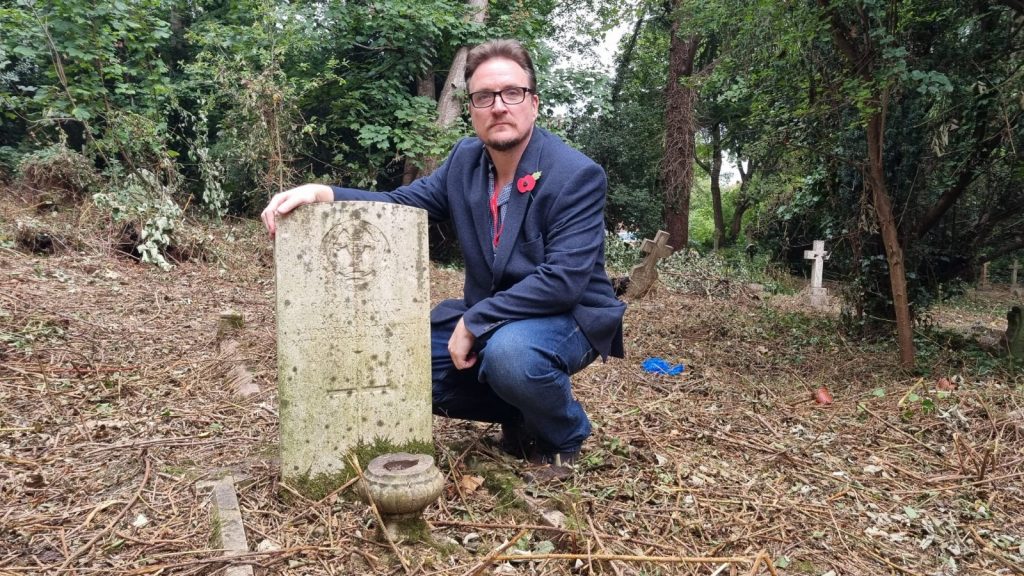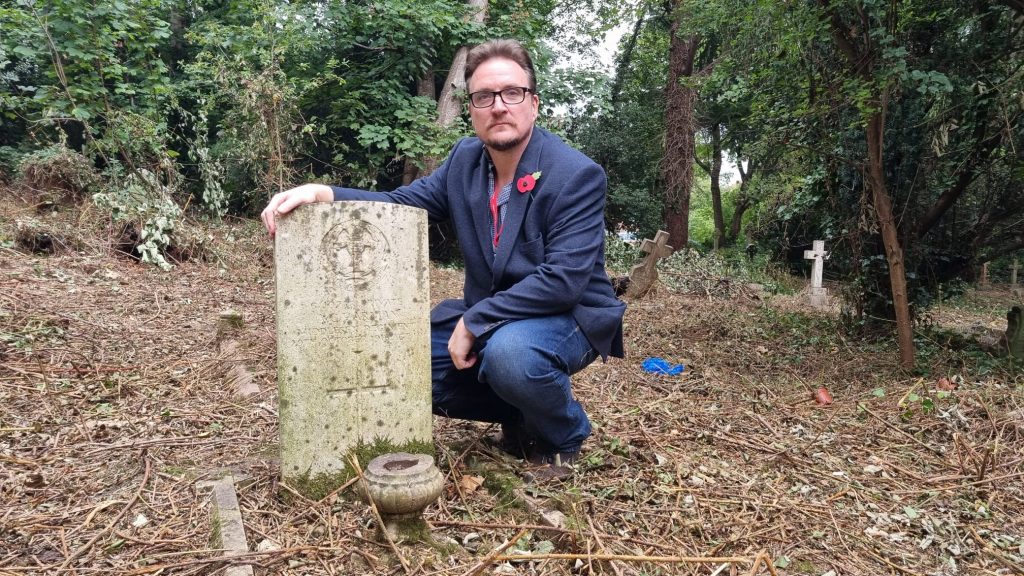
- Historic war grave site in Roxeth Hill Burial Ground commemorating those from Harrow who gave their lives, left overgrown for decades.
- Harrow on the Hill Councillors recently used ward funding to clear a historic Commonwealth war grave site, marking those from Harrow who gave their lives.
- Councillors invite residents to visit graves this Remembrance Weekend, situated in Roxeth Burial Ground by Christ Church, Roxeth.
Harrow on the Hill Ward Councillors, Stephen Hickman and Eden Kulig, have worked closely with Christ Church Roxeth to support vital restoration work at Roxeth Burial Ground, and organise funding to have the overgrown site of a number of First World War graves cleared in time for this Remembrance Day weekend. Sitting overgrown and untended for several years, this work marks an important effort by the local community, in alliance with ward Councillors, to bring a historic site back into regular public use.
The project, carried out by Harrow’s Parks and Cemeteries Team, has reopened access to the site, revealed long-hidden graves, and protected headstones from further damage and decay. Dating back to 1902, the burial ground contains five Commonwealth War Graves alongside many other local residents’ memorials. The graves are now clear, and access can be found via Christ Church Roxeth car park.
This work holds particular poignancy ahead of Remembrance Sunday. Among those laid to rest are Rifleman G. Macdonald, 2nd Corporal D. McCallum, Rifleman A. McCallum, Private A.C. Harman, and Able Seaman F. Field. The cemetery is also the resting place of Sir William Henry Perkin, the pioneering chemist whose discovery of mauveine – the first synthetic dye – revolutionised the chemical industry.
While further restoration is planned, this clearance marks an important first step in safeguarding a historic and special place in Harrow on the Hill.
Clir Stephen Hickman said:
“It has been a pleasure to work with colleagues from Christ Church Roxeth. This project has been about preserving local heritage, ensuring safe access for visitors, and maintaining the dignity of those who rest at Roxeth Hill Burial Ground. We owe so much to those who gave their lives in the world wars, and it has been a privilege to help restore these graves. I look forward to seeing this site valued once again as a place of reflection and community interest.”
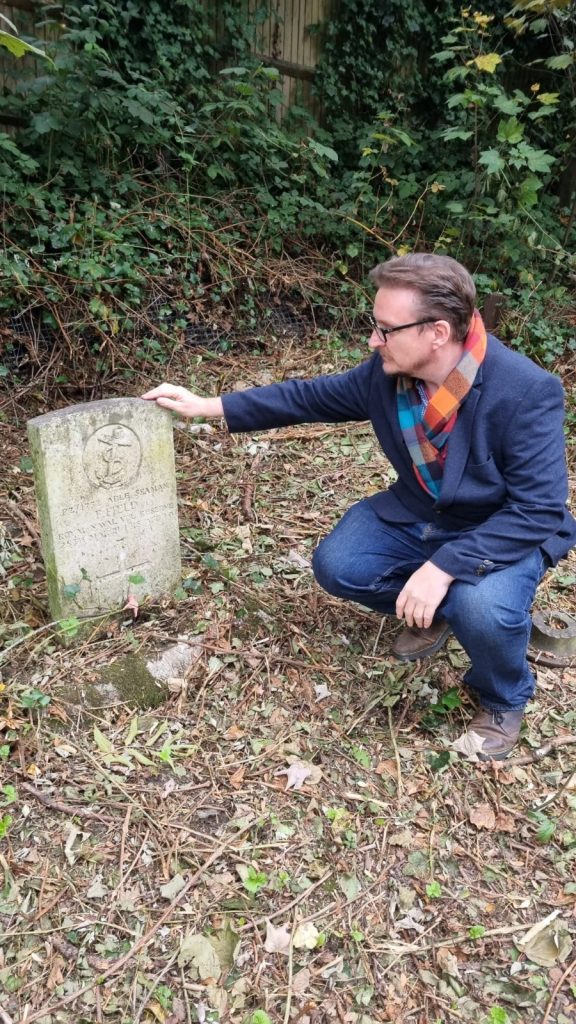
Able Seaman Fred Field
Field was born in Buckinghamshire on 16th January 1898, but soon moved to Harrow with his family, settling in a house on Wellington Terrace, West Street, Harrow-on-the-Hill, before finally moving to a cottage on Northolt Road.
Field was still a young teenager when the First World War broke out, and in 1916 at the age of 18, Field was drafted into the army reserve, joining the Hawke Battalion, a unit within the 63rd Royal Naval Division, a year later. Whilst it is unclear what role Field would have played, his battalion operated out of the trenches in Northern France, and it is likely he would have played a role in events such as the Second Battle of Aras and the Operations on the Ancre.
However, four months into his deployment, Field fell seriously ill and was invalided back to the UK in May 1917. It became clear that he was too unwell to return to the trenches, and as such, he was transferred to the Royal Navy Volunteer Reserve in Crystal Palace, where he continued to train and serve King and Country whilst battling illness.
Unfortunately, on 25th March 1918, Field died in hospital of diabetes mellitus and pulmonary TB aged 20. His death highlighted that life did not stop during times of conflict: disease and illnesses continued to blight people of all ages. Although he did not die in a shower of bullets, Field demonstrated immense bravery and courage, joining the war at such a young age and continuing to serve his country even when facing his own health battles.
Private Alfred Charles Harman
Harman was a local boy, born in Hendon in May 1897. He was christened by the local vicar in Christ Church, Roxeth, on 26th May 1897, and his family moved into a house on Stanley Road, South Harrow.
Like AS Field, Harman was also a teenager when war broke out, and as soon as he turned 18 in 1915, he enlisted at the Depot in Mill Hill and joined the 11th Battalion of the Middlesex Regiment.
The Middlesex Regiment were heavily involved with trench warfare in France. In 1915, their soldiers were on the front line in key battles such as the Battle of Looes, where the regiment marched across France and attempted to reclaim lost trenches from the Germans.
Harman was awarded the 1914-1915 Star Medal for his service. However, a year later, Harman was wounded on the battlefield and died on 4th November 1916, aged just 19. Upon his death, the Pension Office noted that Harman had only accrued £4 18s 6d, which is equivalent to £290 in today’s money. When his body was returned to the UK, his family chose to bury him in the cemetery at Christ Church, Roxeth, the same church he was christened in.